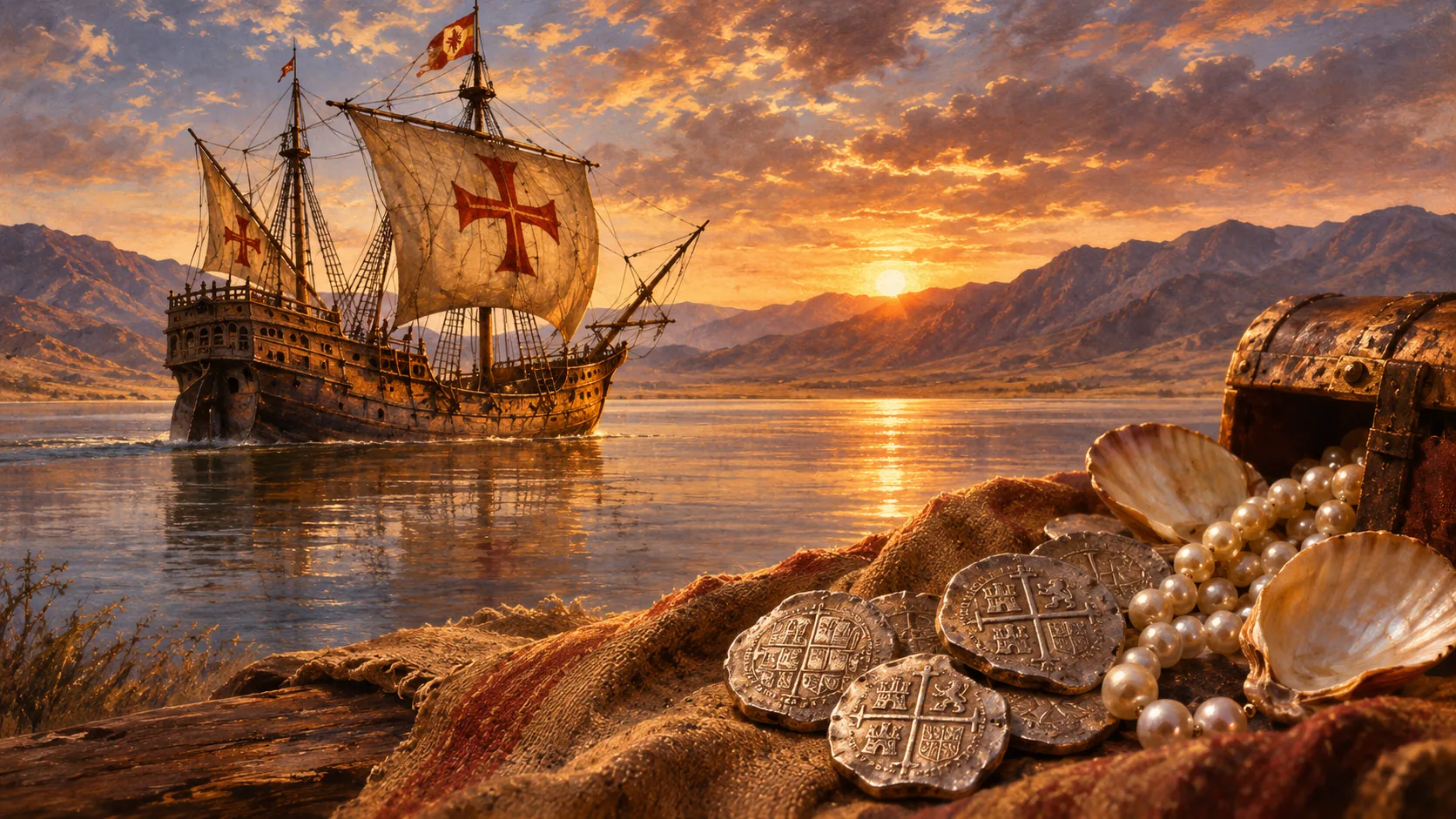
A Ship with Many Stories
What began as reports of a mysterious vessel in the Colorado Desert eventually grew into something far more extraordinary.
As the legend passed from one storyteller to another, the ship acquired a cargo, a crew, and even a possible identity.
In some versions, it was a Spanish galleon laden with gold and silver. In others, a smaller vessel carried valuable pearls harvested from the Gulf of California. Some accounts spoke of sailors escaping across the desert, leaving their ship and its riches behind.
But were these descriptions of the same vessel—or entirely different stories that became intertwined over time?
The Pearl Ship of Juan de Iturbe
One of the most intriguing versions concerns Juan de Iturbe, a Spanish mariner associated with pearl-fishing expeditions in the Gulf of California during the early seventeenth century.
According to later retellings, Iturbe sailed northward into a vast inland lake, only to find himself trapped when the waters receded. His crew supposedly abandoned the vessel, leaving behind a valuable cargo of pearls.
There is a historical foundation to part of this story. Iturbe and fellow explorer Nicolás de Cardona were involved in documented voyages to the Gulf of California in 1615–1616.
But the surviving records do not establish that Iturbe entered Lake Cahuilla, became stranded, or abandoned a pearl-laden ship.
The dramatic tale appears in much later storytelling, rather than in the surviving accounts of those voyages.
Gold Beneath the Desert
Pearls were not the only treasure associated with the lost ship.
By the late nineteenth century, stories circulated of a wreck carrying gold, sometimes said to have come from the mines of Arizona.
The promise of buried riches added a powerful attraction to the mystery. Prospectors and adventurers had another reason to search the remote desert, where an unexpected discovery might bring unimaginable wealth.
Yet despite the rumors, no authenticated treasure recovered from the legendary ship has established that such a cargo existed.
More Than One Lost Ship?
Not every account described a Spanish vessel.
Other explanations involved a smaller boat or schooner supposedly transported overland and abandoned. Still more imaginative variations introduced Viking ships, pirates, and other mysterious visitors to the desert.
These stories differed in their locations, circumstances, and descriptions of the vessels.
Perhaps some arose independently. Others may have borrowed details from earlier tales, gradually creating the familiar image of a treasure ship buried beneath the desert sands.
The result is not one neatly documented shipwreck, but a collection of stories whose origins are sometimes difficult to separate.
And while the treasures remain unverified, the legend itself has become something of a treasure—a fascinating part of the folklore of the American Southwest.
Following the Trail
For all their differences, many versions of the legend share one remarkable idea: a ship somehow reached a place that is now desert.
But could such a voyage have been possible?
To explore that question, we must travel back to a time when much of the Salton Basin lay beneath the waters of an enormous freshwater lake.
The Vanished SeaHistorical Sources
- Don Laylander, “Early Strangers on the Lower Colorado River and in the California Deserts: The Factual, the Implausible, and the Problematic.” Pacific Coast Archaeological Society Quarterly, Vol. 56, No. 1, 2021, pp. 25–39.
- Albert S. Evans, “In the Valley of the Shadow.” The Galaxy, January 1870, pp. 89–93.
- Perplexity Research — The Lost Ship of the Desert, project research compilation. Used to identify additional literary and newspaper leads; original archival verification remains a future research task.